Discover Ombrae

Our approach to any Ombrae project, from architecture to product design, follows four well-defined phases. This creative development method is flexible — allowing for meaningful collaboration and ideation — yet remains sufficiently rigorous to ensure timely and satisfactory final results.

At the beginning of each project, we strive to uncover the key factors of the project in relation to context, scale, application, site considerations, client design intent, and unique opportunities. In turn, Ombrae Studios helps clients truly discover Ombrae: educating project stakeholders on the opportunities and features of Ombrae imaging technology and providing initial feedback based on our extensive experience.

Activities

  • Client training on the product
  • Application recommendations
  • Material research (if necessary)
  • Production considerations
  • Project roadmap

Based on the factors and insights revealed in the Discovery phase, Ombrae Studios works closely with the design team and our manufacturing partners to define a proposal aligned with the client’s values and aspirations. This initial proposal presents a conceptual vision of the project with the integration of Ombrae: realized through sketches, photocomposites, proposed input artwork, and virtual 3D models.

Once the stakeholder team agrees to specify Ombrae in the project, our team advances the design direction with increasingly refined iterations, considering all levels of input that determine the final outcome of Ombrae: grayscale artwork, environmental factors, intervention area, view optimization, and material color/finish.

Key activities

  • Preliminary site/application analysis
  • Concept generation
  • Scope definition
  • Preliminary design iterations
  • Resolution testing
  • Consultation on material color/finish

Key activities

  • Artwork refinement + approval Finalization of view optimization
  • Finalization of coverage area
  • Lighting consultation
  • Finalization of panel/part drawings (Manufacturing partner)

Once the stakeholder team agrees to specify Ombrae in the project, our team advances the design direction with increasingly refined iterations, considering all levels of input that determine the final outcome of Ombrae: grayscale artwork, environmental factors, intervention area, view optimization, and material color/finish.

After the client’s final approval of the design, Ombrae Studios proceeds with the coding phase, which involves creating the tooling drawings and product production. We have spent years building a well-established global network of leading manufacturing partners, both for architectural and product design applications, who follow the project through fabrication, finishing, shipping, and installation.

Key activities

  • Production drawings
  • The partner completes the delivery of the Ombrae product

What is Ombrae and what is Sculptural Imaging

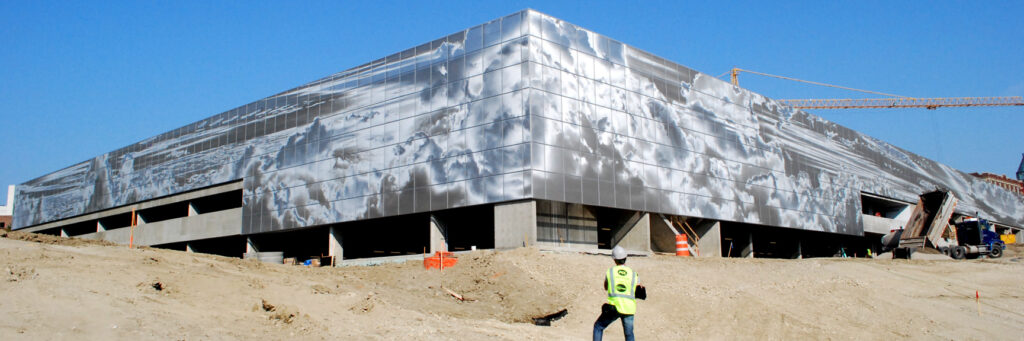
Ombrae is a technology that transforms images and patterns into sculpted three-dimensional surfaces, where the material’s shape itself generates the visual effect. Instead of using flat pixels like on a screen, the image is “translated” into a dense array of tiny reliefs or three-dimensional cells. Each cell has precise geometry and inclination, designed so that when light hits the surface, some parts are strongly illuminated, others remain in shadow, and others reflect light towards the observer. It is this controlled play of light and shadow that produces, on the scale of the entire facade or object, a readable image.

The process always starts from an image or a grayscale drawing. Each gray value is associated with a geometric configuration of the cell: an area in the original image that is very bright can be represented by a cell more exposed to light, while a dark area will correspond to a cell more shielded or oriented to remain in shadow.

A dedicated software performs this mapping and generates a continuous three-dimensional model of the surface, consisting of thousands or millions of these micro-units.

Subsequently, this geometry is transferred onto real materials, through production techniques such as molding, punching, laser cutting, or CNC machining, giving rise to metal, composite, or plastic panels that have the image “engraved” in their very structure.

Preliminary analysis
Material consultation
Concept
Project definition
Design iteration
Final test

The same surface can appear different depending on the time of day, the position of the sun, the type of artificial lighting, and the point from which the observer views it.

From afar, the overall image is perceived, for example, a portrait or a logo, while up close, the three-dimensional texture and detail of the geometric units dominate.

From an optical point of view, the principle is that of a bas-relief. The image is not made of pigments, but of differences in light and shadow generated by three-dimensionality achieving a dynamic result.

Artwork refinement
View optimization
Performance layers -
Coverage finalization
Lighting consultation
Panel finalization

The “technological” component of Ombrae lies precisely in the ability to control this effect precisely and repeatably.
Starting from parametric modeling, light simulation, the study of material reflectance, and the environmental conditions in which the surface will be installed. In architecture, all this allows not only to achieve an aesthetic result but also to improve the performance of the envelope: Ombrae panels can help to shade the sun, reduce glare, filter natural light, and ensure a certain degree of privacy, while remaining a visual communication and identity element for the building.